Cultural Capital Doesn’t Pay the Rent: a queer memoir
Out Spring 2026
Available for pre-sale now on PM Press
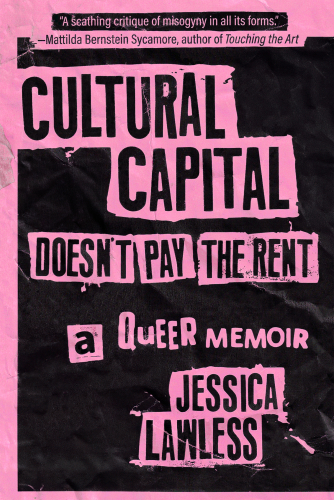
My memoir about loss, economic survival and three decades of organizing against the interlocking hellscapes of neo-liberal capitalism is being published by PM Press. Reflecting on the past while entering menopause, I piece together a queer, anarcho-punk history of trauma-informed community care, healing justice, and mutual aid. Cultural Capital Doesn’t Pay the Rent explores the somatic impacts of remembering and forgetting while taking an intimate journey through the hope and hypocrisy of leftist activism, the academic art world, and the US labor movement.
You can click here to read the 2014 interview on Inside Higher Ed where I first uttered the phrase that became the name of my book.
“Granular in detail and expansive in scope, Cultural Capital Doesn’t Pay the Rent bursts with the possibilities of self-actualization, mutual aid, and collective struggle. Resisting the redemptive arc to tell the truth about surviving domestic violence, the myth of upward mobility in academia, and the limitations of union organizing, Lawless offers not only a scathing critique of misogyny in all its forms but also an abolitionist analysis grounded in a quest for accountability and a desire to transform everything. I dare you to read this book without sobbing.”
—Mattilda Bernstein Sycamore, author of Touching the Art
“Raw, brilliant, and uncompromising. Jessica Lawless captures the brutal reality of coming of age as a queer, working-class feminist in the wreckage of the American Dream. From the punk clubs of Seattle to the adjunct trenches of academia to the belly of the labor movement, Lawless traces a path through three decades of survival, resistance, and heartbreak with the fierce intelligence of someone who’s lived every contradiction of late-stage capitalism. This is memoir at its most essential—no nostalgia, no easy answers, just the hard-won wisdom of a hard-working human who refused to be broken by a world designed to destroy us. Both deeply personal and urgently political.”
—Ariel Gore, author of We Were Witches
“In a voice all her own, Jessica Lawless takes readers on a journey that so many of us will recognize, through all the failing institutions of the past several decades: the family, the workplace, the activist movements promising to save us. She writes of her life with unflinching honesty, sparing herself least of all, through punk rock and queer community, in feminist self-defense work and art practice and finally labor unions. She offers no easy answers but dares to dream of movements that are built on a different set of values: an abolitionist feminist labor movement, one that challenges us once and for all to find meaning in our connections rather than our work.”
—Sarah Jaffe, author of From the Ashes and Work Won’t Love You Back
“Cultural Capital Doesn’t Pay the Rent is all at once memoir and call to action; a history of violence and a love letter to queers and artists and freaks; a classic story of American poverty and an exceptional anticapitalist analysis from an organizer who dreams of something better for us all. Through her immersive storytelling, Jessica Lawless offers us a rich archive of a radical past that holds necessary wisdom for anyone who wants a better world.”
—Rachael Anne Jolie, author of Rust Belt Femme
Three Essays on Art, Academia, and Economics
Chapter in Feminisms in Motion: Voices for Justice, Liberation, and Transformation (AK Press, 2018)
From 2007-2017, a small Los Angeles-based magazine called make/shift published some of the most inspiring feminist writers of the decade, articulating ideas from the grassroots and amplifying feminist voices on immigration, state-violence, climate change, and other issues.
“In the contemporary political moment, when there is such an urgency to act, these writers insist that we consistently critique our analyses and approaches, and remind us how vitally important explicitly intersectional, multi-issue organizing strategies are to the success of our movements. Feminisms in Motion provides both a historical record of significant antiracist feminist interventions and a roadmap for moving us in the direction of freedom and justice.”
– Angela Y. Davis
I was a regular contributor to make/shift over the decade it existed. I wrote essays and book and film reviews, including the pieces that are included in the anthology. You can click here to read one of my favorite interviews I did for the magazine. It was with Alicia Bell and Melissa Crosby of the black.seed collective, a Black female, femme, queer-led group of activists who shut down the Bay Bridge connecting Oakland and San Francisco on MLK Day 2016.
Doing the Math
Chapter in Places Like Home (Literary Kitchen, 2020)
Edited by Ariel Gore, Places Like Home is an anthology by the School for Wayward Writers, “…a network, a community, a secret society of writers and art-makers. We are beginners. We’ve been at this for decades. We are bestselling authors. We’re recluses who only create for ourselves and each other. We are MFA professors, sex workers, high school dropouts, administrative assistants—and sometimes all of the above.”
Excerpt from my chapter: “I dream of shutting myself inside my house, writing while subsisting on unemployment, food stamps, and the feel of the wind as I watch it move through the leaves outside the window. Then I remember how impossible it was to access creativity when I was unemployed, how impossible it was to step back from my distraught over worsening debt and no viable job options. The back pain. The weight gain. The fear of homelessness. Again. The constant fighting with my partner over buying books, weed, getting my eyebrows done, contributing to his sister’s rehab instead of saving for new tattoos. It wasn’t romantic.”
You Dropped a Bomb on Me
Chapter in Resolutions 3: Global Networks of Video (University of Minnesota Press, 2012)
Edited by Ming Yuen S. Ma and Erika Sudenberg. Resolutions 3 explores the wide-ranging implications of video art and video-based production in contemporary media culture. The contributors to this volume investigate the ever-changing state of video’s deployment as examiner, tool, journal reportage, improvisation, witness, riff, leverage, and document. My chapter, “You Dropped a Bomb on Me,” examines queer femme identity and questions of representing queer genders in film and media that may not immediately read as queer.
Excerpt from my chapter: “Sitting in a bar, lesbian or straight, I may not be read as queer in either. If I consciously name myself a [trans-loving] queer femme, all sorts of invisible social relations become visible, ensuring passing is not the operative mode. Naming myself something other than lesbian, queers my location in both hetero- and homonormative spaces. What is significant in that radical action is more than just naming and visibility: it is the intent to blow up normative social relations.”
The Anarchist Review of Books
The Anarchist Review of Books publishes intelligent, non-academic writing with an anti-authoritarian perspective. We are dedicated to transforming society through literature and through open, incisive critique of the media, politics, history, art and writing that shape our world.
- Interview with Sarah Jaffe on her book Work Won’t Love You Back (in Issue #4, Summer/Fall 2022)
- Review of Abolish the Family: A Manifesto for Care and Liberation by Sophie Lewis (in Issue #5, Winter/Spring 2023)
- Review of It Did Happen Here: An Antifascist People’s History edited by Bowstern, Crenshaw, Dunn, Flores, Perini, and Yanke (in Issue #7, Winter/Spring 2024)
Labor Day Thoughts on Misogyny, White Supremacy,
and Collective Grieving
2017 post on Cultural Capital Doesn’t Pay the Rent Blog
A piece I wrote when the new White Nationalist Movement marched on Charlottesville.
Excerpt from the piece: “I got home intending to spend the whole weekend writing. Instead I watched news clip after news clip of the president being a white supremacist apologist until my partner says, ‘maybe you should do something else.’ I pour a drink.”
Reclaiming the Artist: Organizing Through Art
2016 post on the New Faculty Majority’s Majority Rule
A three-part series I wrote about how I had been using art as an artist/professor turned union organizer in a national SEIU campaign building adjunct professor unions. Requested by the New Faculty Majority, a significant advocacy organiztion working outisde of, but alongside union and electoral campaigns in the early and mid 2000’s.
Excerpt from the piece: “Today I am clear I am still an artist. I found my way back to my art practice through organizing—in part because I am not living as day-to-day as I had been, so I am able to focus on other things besides (not) getting by. In another part, it is because as an artist I have always sought out where and how art and activism meet and I’ve had the opportunity to bring that inquiry to my job. It wasn’t immediate and I didn’t do it alone.”
Ponzi Schemes, Bastards of Neoliberalism, and Social Justice Intelligence: An Interview with Jessica Lawless on Union Organizing in Academe and Other Topics
A 2016 interview by Pete Sinnott
in The Contrivers Review
Excerpt from this strong analysis when I was still thinking like and academic: “Similar to my job search post–911, I applied to tenure track positions and was
met with very collegial letters letting me know the position had been defunded, the program was being shut down, or “We received applications from more qualified candidates than ever before, sorry you aren’t one to get an interview.” I attended College Art Association conferences, took advantage of any workshops and mentoring for the job market. I was told my materials were strong, my letters of interest pithy, just keep trying. It became clear MFAs were a Madoff level Ponzi scheme. Eight years later, when I became a union organizer at art schools—a complicated process pragmatically and emotionally—the Ponzi scheme had been cemented through the administrative university, adjunctification of the professoriate, and staggering debt for students.”
 Jessica Lawless